Bogotá’s Concert Arena: Rain Falls and Music Plays
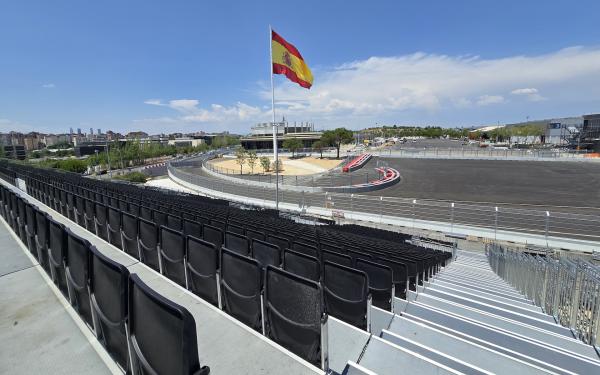
In Bogotá, Colombia, a modular concert arena with a capacity of 45,000 was built at an altitude of 2,600 meters – constructed by NUSSLI in just three months and designed to remain in operation for up to ten years.
Something has changed in Bogotá’s concert scene. Where until recently there was no suitable infrastructure for large-scale events, the sprawling U-shaped Vive Claró Arena now stands, with room for around 45,000 spectators. It was built by NUSSLI, an internationally operating company specializing in modular event structures that has already been deployed for Formula 1, the Olympic Games, and renowned open-air festivals worldwide. The opening took place on August 24, 2025: Green Day was the first band to rock the new venue.

Three branches, one project
The project was carried out through close collaboration between the NUSSLI branches in Switzerland, Spain, and Mexico. Speaking on behalf of the project team, Daniela Rugeles summarizes the challenge: “This was our first project of this scale in Colombia. We had to take every detail into account, from climatic conditions to structural engineering.” The grandstand structure is based on the proven NUSSLI system and meets all local earthquake and safety standards.
A technical masterpiece at 2,600 meters
The arena features 17,300 regular seats as well as 1,400 VIP seats in two exclusive sections with separate staircases. Twentytwo concession stands were integrated beneath the grandstands. A requirement that was directly factored into the structural calculations. The high altitude and weather added to the challenges: Bogotá lies at around 2,600 meters above sea level, and rain was a near-daily occurrence. “There were hardly two days without rain. The conditions were challenging, but our team worked with incredible dedication,” Rugeles explains. Logistically, the project was also demanding: 70 shipping containers of materials from Europe had to be coordinated, temporarily stored, and deployed with pinpoint precision. Assembly took place from early April to early July 2025.
Up to ten years in operation
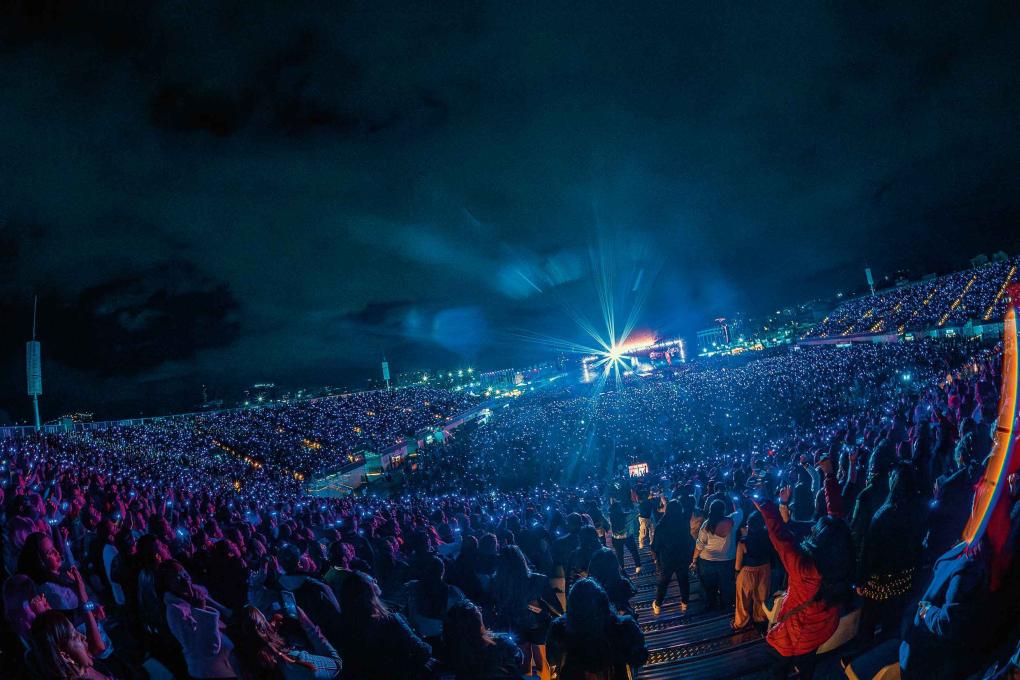
Although designed as a temporary structure, the arena will not be dismantled for the time being. The operator, OCESA Colombia, signed a long-term usage Agreement with the city of Bogotá. The structure is expected to serve as a permanent venue for national and international concerts for up to ten years. It quickly became clear that the demand was there: On November 1, 2025, Shakira returned to her hometown with her “Las Mujeres Ya No Lloran World Tour.” Before a sold-out crowd, she performed a program lasting more than two hours that spanned her entire career.
Expertise, Flexibility, Results
For Danilo Della Ca, COO of Event Structures at NUSSLI, the Bogotá project exemplifies what internationally oriented teamwork can achieve: “Projects like this show what is possible when expertise, passion, and flexibility come together. Our teams have proven that modular Engineering expertise sets global standards – even under tropical rain.” (stadiaworld, 22.05.2026)


- Company site: NÜSSLI Gruppe